The recognition of Earth's orbital cyclicity in the geologic record and
its link with periodic variation in orbital parameters (precession,
obliquity, eccentricity) has been instrumental in improving our
understanding of past climate changes at different time scales. To this
aim, some intervals of the Cretaceous, a period of Earth's history ranging from 135 to 65,5 million years ago, are considered among the possible proxies of warm phases of the near future climate extremes.
Our experience is mostly centred on the study of Cretaceous shallow marine carbonates which, by their organogenic nature, are strictly related to biosphere and directly controlled by sea level changes modulated by climate variations. As other sedimentary rocks, shallow-water carbonates may be studied by means of facies analysis (interpretation, at cm- to dm-scale, of depositional textures and early diagenetic products).
The Mesozoic carbonates that we have studied may be viewed as a rich
archive of the history of both the hydrosphere-atmosphere and shallow-
marine biosphere. Climate, controlling the paleoceanographic parameters,
directly influenced the sedimentary productivity and the environmental
evolution of these deposits at a time-scale ranging from 10- to 100.000
years; on this basis their detailed analysis allows a precision one-two
orders of magnitude higher than the resolution of current time scales.
To this purpose in the last few years there has been a growing interest
for the biosedimentary rhythms (cycles) registered in stratal rock
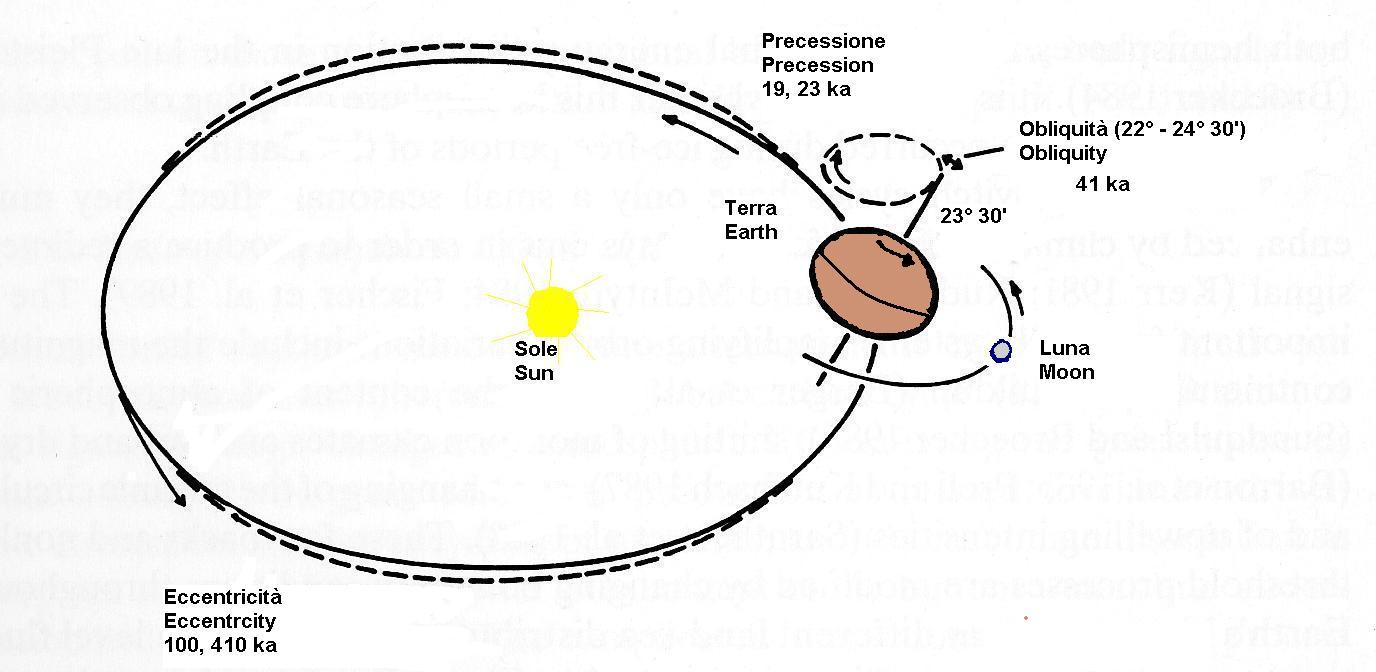
sequences (cylostratigraphy). These rhythms largely reflect a global
control on climate changes by the Earth's orbital cycles (Milankovitch
cycles, Fig.1).
Cretaceous shallow-water carbonates of Italy show an organization of their strata in a hierarchy formed of elementary cycles, bundles and superbundles (groups of bundles). Composite paleoceanographic fluctuations, modulated by global climate changes explain this hierarchy, allowing elementary cycles to be related to the periodicities of the precession (circa 20.000years) and/or obliquity (circa 40.000years) while bundles and superbundles to the periodicities of the short- (circa 100.000 years) and long-eccentricity (circa 400.000 years) respectively.
On these bases shallow-marine carbonates may be used to investigate ancient global climate changes and to attempt high-precision (100.000
years) correlations among coeval rock sequences, and hence more refined
paleoceanographic reconstructions quantitatively bracketed by means of
orbital chronostratigraphy (numerical age dating).
This research project (CAMAB) has been coordinated in the last 10 years
by Bruno D'Argenio and carried out by S. Amodio, F.P. Buonocunto, M.
Iorio, N. Pelosi and A. Raspini (Geomare sud, CNR) and V. Ferreri
(Earth's Science Department, Naples University). Other contributors are: G. Longo (Physics Dep., Naples University), R. Tagliaferri (Physics Dep., Salerno University) and H. Weissert (ETH Institute Zurich). The most recent results are in press on a SEPM (International Society for Sedimentary Geology) Special Volume: "Cyclostratigraphy. An essay of approaches and case histories"(editors B. D'Argenio, A.G. Fischer, I. Premoli Silva H. Weissert and V. Ferreri).
Immagini: