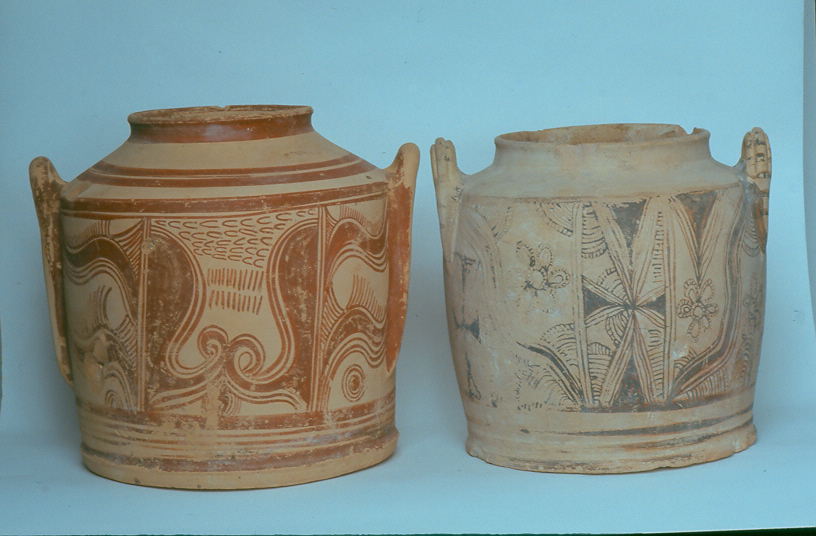
One of the main researches carried out by ICEVO concerns the study of the
relations between the Mycenaean society, which flourished in the Aegean in
the second half of the II millennium BC, and two specific areas of the
Mediterranean selected for case studies: the island of Crete and the
central Mediterranean. ICEVO has acquired a leading role in this branch of
Aegean archaeology, as the numerous scientific projects and several
publications may show.
As for Crete, the political entities developed on Mainland Greece and on
the island show such a variety of connections that it proves difficult to
form a unifying pattern through time. In the 12th century BC, after the
collapse of the Mycenaean 'early states', new settlements were founded all
over Crete, some of them including people coming from the Greek mainland
and thus giving place to a new, intense phenomenon of interaction between
the two areas. In order to clarify aspects of this relationship ICEVO is
active on the island with two investigations concerning settelement and
funerary evidence.
The archaeological enquiry of the ancient city of Sybrita, on the hill of
Thronos/Kephala in central-western Crete, aims at the reconstruction of
the cultural identity of this centre, which may become a model to
understand the processes leading in the 12th century BC to the formation
of new settlements, which may be regarded as sort of 'colonies'. This
enquiry is carried out at different levels - archaeological excavations,
paleoenvironmental reconstruction, analysis of bioarchaeological material
as animal bones and paleobotanic remains - and is financed by CNR, Scuola
Archeologica Italiana di Atene and 25th Ephoria for Prehistoric and
Classical Antiquities of Chania (Greece). Moreover, the collaboration with
the local administration of the modern village of Thronos will lead to the
opening of a permanent exhibition on ancient Sybrita.
On the other hand, the research at Kritsa, in Eastern Crete, in
collaboration with the 24° Ephoria for Prehistoric and Classical
Antiquities of Ayios Nikolaos, is focused on the funerary evidence
deriving from a necropolis in use between the 14° and 11° century BC,
offering outstanding elements for the study of interconnection with
Mycenaean Greece. This research beyond the acquisition of new data, is
aimed to the recovery of architectural monuments and related finds,
underestimated for too long a time.
Immagini: